Car air con not blowing cold: causes, regas or repair, and which refrigerant your car uses
Warm air from the vents usually means low refrigerant, but not always. The common causes, how a regas differs from a repair, which refrigerant your car takes, and why air con matters in winter too.
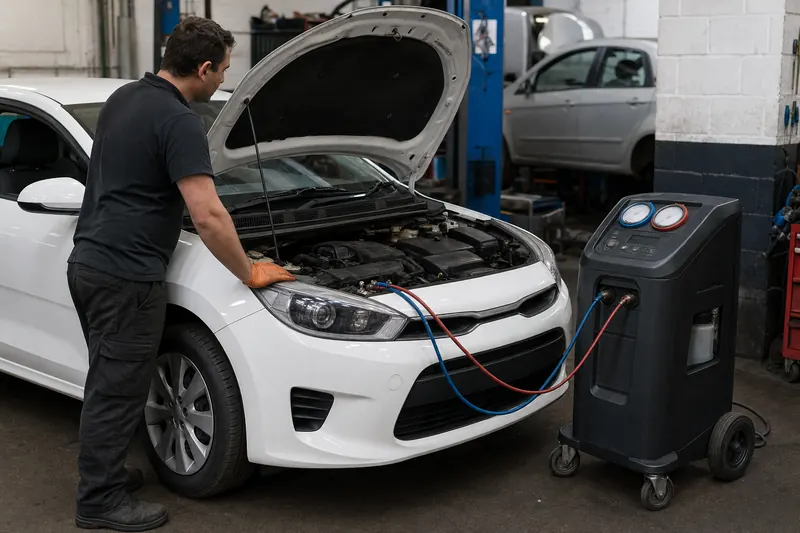
When car air con stops blowing cold, the most likely cause is low refrigerant, either from slow seepage over several years or from a leak. The other common causes are a compressor that is not switching on, a failed condenser fan, an electrical fault such as a blown fuse or pressure switch, or, on cars with climate control, a stuck flap that mixes in warm air. A weak flow of air, rather than warm air, usually points to a blocked cabin filter.
Car air con not blowing cold? Quick checks first
A few simple checks can rule out the easy causes before you pay for anything:
- Make sure the A/C button is on and its light is lit, and the temperature is set to cold.
- Turn the fan up. If air barely comes out at any speed, the cabin filter or blower is the likely problem, not the cooling.
- With the engine idling, switch the A/C on and listen. On many cars you will hear a click from the engine bay and the idle will dip slightly as the compressor engages.
- Notice when it fails. Air that is cold on the motorway but warm in traffic often points to the condenser fan.
- Check whether one side of the cabin is cold and the other warm. That points to a flap or its motor, not the refrigerant.
Low refrigerant: the usual cause
Low refrigerant is the most common reason car air con blows warm, because every system loses a little over time through its seals and hoses. Even the type approval rules for new car designs allow a leak rate of up to 40 grams a year for a system with a single evaporator. Over several years that adds up, and the cooling fades gradually rather than stopping overnight.
A regas fixes this. The service machine recovers whatever refrigerant is left, holds the system under vacuum to boil off moisture and check that it holds, then refills it with the exact weight of refrigerant and oil the manufacturer specifies. Many garages also add a UV dye so any leak can be traced later.
If the cooling faded slowly over years and the system holds its vacuum, a regas is usually all it needs. If it went from cold to warm in weeks, or a regas only lasts a season, there is a leak.
Leaks: where they happen and how they are found
The most common leak points are the condenser, the hose joints and the compressor seal. The condenser sits at the very front of the car, ahead of the radiator and behind the bumper grille, where stones, road salt and corrosion attack it. The rubber O-rings at each joint harden with age. The evaporator, buried behind the dashboard, can leak too, and that is the most labour-heavy repair.
Leaks are found with UV dye and a lamp, an electronic detector, or by pressure testing the empty system. Once found, the leaking part is replaced before the system is refilled. That order is not optional: the rules on car air con say that if abnormal leakage is found, the system must not be refilled until the leak is repaired. Refilling a leaking system wastes your money and lets the refrigerant escape into the atmosphere.
A front-end collision can crack the condenser even when the visible damage looks light. If your air con stopped working after a bump, the condenser should be part of the repair, and our guide to non-fault accident claims explains how claims work when someone else was to blame.
Compressor, condenser fan and electrical faults
If the system is full of refrigerant but the air is still warm, the fault is usually the compressor, the condenser fan or the electrics that control them. The compressor pumps the refrigerant around the system. On many cars it is switched by an electromagnetic clutch, and a worn clutch, a failed relay or a faulty pressure switch will stop it engaging even when the compressor itself is fine.
The condenser fan pulls air through the condenser when the car is moving slowly. If it fails, the air con works on the open road, where air is forced through the front of the car, but fades in traffic. On cars with automatic climate control, sensors and flap motors decide where the cold air goes. A faulty one can leave one side of the cabin warm or the vents stuck on the screen.
Climate control units store fault codes like the engine does, so a diagnostic check is the quickest way to find an electrical fault. Our guide to dashboard warning lights and diagnostics explains what that check reads.
Smells and weak airflow
A musty smell from the vents is usually bacteria and mould growing on the damp evaporator, and weak airflow is usually a clogged cabin filter. The evaporator gets cold and wet every time the air con runs, and if the system is rarely used, or the car is always switched off straight after a cold blast, it never dries out.
Replacing the cabin filter and treating the evaporator with an antibacterial cleaner usually clears it. The cabin filter is one of the items on the schedule for a full service; our guide to interim and full car services covers what else gets replaced.
R134a or R1234yf: which does your car use?
Most cars built before the mid-2010s use a refrigerant called R134a, and most newer cars use R1234yf. The change was driven by rules on greenhouse gases. From 1 January 2011, new car designs could not be approved with an air con system meant for refrigerant with a global warming potential above 150, and from 1 January 2017 that limit applied to every new car sold. R134a is far above that limit. R1234yf is well below it and became the standard replacement.
Model years overlap, so the age of the car is only a guide. The reliable way to tell is the label in the engine bay, usually on the slam panel or under the bonnet, which states the refrigerant type and the charge weight.
The two gases are not interchangeable. They use different service connectors and need separate equipment, and a system must only be filled with the refrigerant it was designed for. Older systems built for R134a can still be refilled with it. R1234yf costs more, so a regas on a newer car is usually more expensive than on an older one. Kwik Fit's published prices in April 2026, for example, started at £74.95 for an R134a regas and £139.95 for R1234yf.
Regas or repair?
A regas is the right fix when the cooling has faded slowly and the system holds a vacuum; a repair is needed when the system has lost its charge quickly, will not hold a vacuum, or the compressor will not engage with enough refrigerant in it. The vacuum stage of a regas is a useful test in itself, because a system that will not hold vacuum has a leak large enough to need finding first.
Car air con work is regulated. You must have a qualification to recover refrigerant from the air con systems of passenger cars with eight seats or fewer and vans under 3,500kg, and it is done with a recovery machine that captures the gas.
We would steer clear of DIY top-up cans. You cannot see how much refrigerant is already in the system, overfilling hurts cooling and strains the compressor, and the leak that caused the problem is still there.
Why air con matters in winter
Air con earns its keep in winter too, because it dries the air as well as cooling it, and dry air clears a misted windscreen much faster than the heater alone. Many cars switch the compressor on automatically when you select the windscreen demist setting for exactly this reason.
That has a legal side too. Rule 229 of the Highway Code says that before setting off you must be able to see, and that you should make sure the windows are demisted thoroughly. On a cold, wet morning, a car with broken air con can take a long time to clear, and pulling away with a half-clear screen is how cyclists get missed at junctions.
Running the air con for a while every week or so through the winter also keeps oil moving around the system, which helps keep the seals in good condition.
Air con repairs in Barking
At Precise Panels, we work on air conditioning and climate control at our workshop on Barking Industrial Park, Alfreds Way, from regas to leak tracing and component repairs, and we test the system before refilling it. Free collection and delivery is available if you cannot get away from work.
Tell us your car's make, model and year, and what the air con is doing, through the quote form or on WhatsApp. You can also call 020 3645 8132 or see our other mechanical services.
Frequently asked questions
The most common cause is low refrigerant, from slow seepage over the years or a leak. Other causes include a compressor that is not engaging, a failed condenser fan, a blown fuse or faulty pressure switch, or a stuck blend flap on cars with climate control. A test of the system pressures and a diagnostic check narrow it down.
There is no legal interval, and handbooks vary. Regas when the cooling has noticeably dropped off. If a system needs another regas within a year or so, it has a leak that should be found and repaired rather than topped up again.
No. A system should only be filled with the refrigerant it was designed for. The two use different service connectors and need separate equipment. The label in your engine bay states which refrigerant your car takes and how much.
A musty smell usually comes from bacteria and mould on the evaporator, which gets damp every time the air con runs. A new cabin filter and an antibacterial treatment of the evaporator normally clear it.
Yes. Air con dries the air, which clears a misted windscreen much faster, and the Highway Code says your windows should be demisted thoroughly before you set off. Regular use also keeps oil circulating, which helps the system's seals.
Sources
- Directive 2006/40/EC on air conditioning in motor vehicles, article 5 (legislation.gov.uk)
- Directive 2006/40/EC, article 6: retrofitting and refilling (legislation.gov.uk)
- Mobile air conditioning (cars and vans): F-gas controls (NetRegs)
- F-gas handler for air-conditioning systems in motor vehicles (Regulated professions register, GOV.UK)
- The Highway Code, rule 229: driving in adverse weather conditions (GOV.UK)
- How much does an air con regas cost? (Kwik Fit, April 2026)
This guide is general information from Precise Panels, a car body repair centre in Barking, East London. It is not legal or financial advice.
-
 Mechanical
Interim vs full car service: what's the difference?
An interim service is the six-monthly oil and safety check; a full service is the yearly deep one. Here is what each covers, how to choose, and how service history affects your warranty. -
 Mechanical
Dashboard warning lights explained
Red means stop, amber means book in, but the detail matters. What the common warning lights mean, what a diagnostic check can and can't tell you, and which lamps fail an MOT. -
 Mechanical
Signs of a failing clutch
Revs rising without the speed to match, a biting point creeping up the pedal, judder when pulling away. What each clutch symptom means, where the flywheel fits in, and how to make a clutch last.