Signs your car needs wheel alignment, and tracking vs four-wheel alignment
Pulling to one side, a steering wheel that sits crooked, tyres bald on one edge. What those signs mean, what knocks alignment out, and the difference between tracking and a full four-wheel alignment.
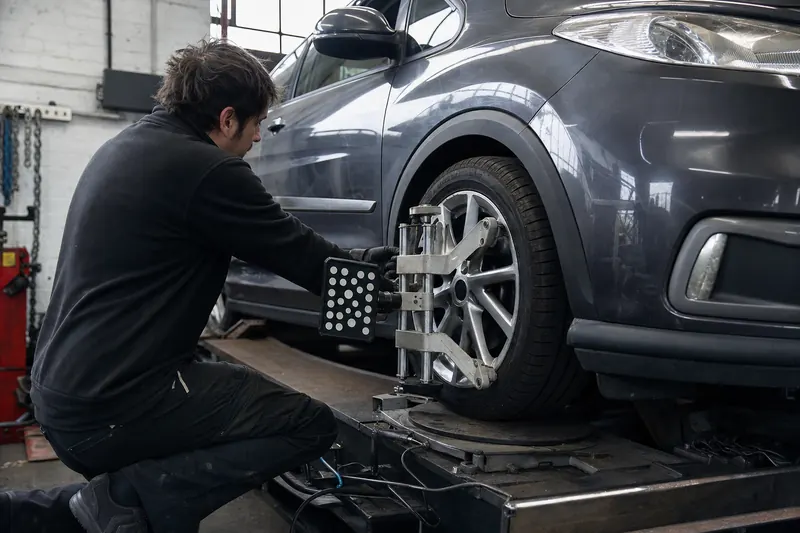
Your car probably needs a wheel alignment if it drifts to one side on a straight, level road, the steering wheel sits off centre when you are driving straight ahead, or the tyres are wearing faster on one edge than the other. Squealing tyres on gentle bends and steering that feels vague or does not return to centre are other signs. A hard knock on a kerb or pothole is the usual trigger.
Bad alignment is easy to live with, which is why it gets ignored. It costs you through tyres that wear out early, and on a car pulling to one side you are correcting the steering all the time without noticing.
What wheel alignment means
Wheel alignment is the set of angles at which each wheel meets the road, and the manufacturer specifies each one to fractions of a degree. There are three main angles:
- Toe is whether the wheels point slightly inwards or outwards when you look down on the car from above. It has the biggest effect on tyre wear.
- Camber is how far the wheel tilts in or out at the top when you look at the car from the front.
- Caster is the angle of the steering pivot, which helps the steering wheel return to centre after a turn.
On most cars, toe is the angle a garage adjusts. Camber and caster are often fixed by the suspension design, so a reading well outside the specification usually means a bent or worn part rather than something to adjust.
Signs your car needs wheel alignment
The clearest sign is a car that will not run straight without you holding the wheel. Try it on a straight, level road with no traffic: if the car drifts steadily to one side, something is off. Most UK roads slope towards the kerb so rain drains away, so a slight drift to the left on some roads is normal.
Other signs to look for:
- The steering wheel is off centre when the car is going straight.
- The inside or outside edge of a tyre is wearing much faster than the rest.
- The tread has a feathered feel, smooth one way and sharp the other when you run your hand across it.
- Tyres squeal on gentle corners at normal speed.
- The steering does not return to centre on its own after a turn.
What knocks alignment out
A single hard impact is the most common reason alignment changes, usually a kerb strike while parking or a pothole hit at speed. TyreSafe, the UK tyre safety charity, advises drivers to check alignment after pothole damage, because driving over potholes can alter steering and suspension geometry or damage suspension parts. East London's roads give plenty of chances.
Alignment also drifts as suspension parts wear. Worn track rod ends, ball joints and suspension bushes let the wheel angles move under load. Replacing those parts, or fitting lowering springs, changes the angles too, so alignment should be checked afterwards.
If you have kerbed a wheel hard enough to mark the alloy, check the alignment as well as the wheel. A buckled or cracked wheel is a safety problem in its own right, and our alloy wheel refurbishment guide explains what can be repaired and what cannot.
Tracking or four-wheel alignment?
Tracking adjusts the toe of the front wheels only, while a four-wheel alignment measures all four wheels and sets the steering straight relative to the direction the rear wheels are pushing the car. On a car with adjustable rear suspension, it sets the rear wheels too.
Many small hatchbacks have a rear beam axle that cannot be adjusted. A four-wheel alignment still measures it, and that is useful: a rear reading out of specification on a fixed axle points to damage from an impact, which front-only tracking would never find.
If your car has independent rear suspension, uneven wear on the rear tyres, or has had a solid knock, a four-wheel alignment is the better choice. For a car that just needs the front toe set after new track rod ends, tracking may be enough.
Wheel alignment cost
Wheel alignment costs about £49 on average in the UK for the front wheels and about £87 for front and rear, according to WhoCanFixMyCar's published averages. These are typical market figures, not our prices. The real cost depends on the car and on whether worn steering or suspension parts need replacing before the wheels can be set.
Uneven tyre wear and the 1.6mm limit
Bad alignment can make a tyre illegal long before the middle of the tread looks worn. The Highway Code says cars must have a tread depth of at least 1.6mm across the central three-quarters of the breadth of the tread and around the entire circumference. A tyre also breaks the law if any of its ply or cord is exposed, wherever that happens on the tread.
That matters with alignment wear because the inside edge of a front tyre is the part you cannot see. The outer half can look healthy while the inner shoulder is down to the cords. Tread that does not meet the requirement is a dangerous defect at the MOT. On the road, using a vehicle with defective tyres is an endorsable offence (code CU30) that carries three penalty points as well as a fine.
The wear pattern often points to the cause:
| Wear pattern | Likely cause |
|---|---|
| Both outer edges worn | Under-inflation |
| Centre of the tread worn | Over-inflation |
| One edge only, inner or outer | Camber or toe out of specification |
| Feathered across the tread | Toe out of specification |
| Scalloped patches around the tyre | Worn shock absorbers or an unbalanced wheel |
Problems that feel like bad alignment
A pull or shake is not always alignment, and a good garage rules out the other causes before adjusting anything. The common ones:
- Uneven tyre pressures. A soft tyre on one side will make the car pull. Check pressures first; it costs nothing.
- A sticking brake. If the pull gets stronger when you brake, or one wheel is much hotter than the others after a drive, a caliper may be dragging. Our guide to the signs your brakes need replacing covers this.
- A damaged tyre. A tyre with internal damage can pull the car to one side. A garage can swap the front wheels side to side and see whether the pull changes direction.
- Wheel balance. Vibration through the steering wheel at motorway speed is usually a balance problem, not alignment. Balancing adds small weights to the wheel; alignment changes its angles.
Worn tyres and steering parts often show up at a service before you notice them on the road. Our guide to interim and full car services explains what gets checked.
Wheel alignment in Barking
At Precise Panels, we carry out wheel alignment at our workshop on Barking Industrial Park, Alfreds Way, and we check tyres, pressures and the steering and suspension parts first, so the alignment holds once it is set. If a kerb or pothole has damaged an alloy at the same time, we refurbish wheels too.
Tell us what the car is doing, and send a photo of any tyre wearing on one edge, through the quote form or on WhatsApp. You can also call 020 3645 8132 or see our other services.
Frequently asked questions
The main signs are the car drifting to one side on a straight, level road, a steering wheel that sits off centre when you drive straight, and tyres wearing faster on one edge. If you have recently hit a kerb or pothole hard, it is worth having the alignment checked even if you have not noticed anything yet.
Tracking is one part of it. Tracking sets the toe angle of the front wheels only. A four-wheel alignment measures all four wheels, sets the rear as well where the suspension can be adjusted, and makes sure the steering is straight relative to the rear wheels.
Yes, if it was a hard hit. TyreSafe advises checking alignment after pothole damage, because potholes can alter the steering and suspension geometry or damage parts. Look at the tyre and wheel as well for bulges, cuts or a buckled rim.
Usually not. Vibration through the steering wheel at speed is normally a wheel balance problem, a buckled wheel or a damaged tyre. Alignment fixes pulling and uneven tyre wear, so the cause needs diagnosing before you pay for the wrong job.
WhoCanFixMyCar's UK averages are about £49 for a front wheel alignment and about £87 for front and rear. Prices vary with the car, and any worn steering or suspension parts have to be replaced before the alignment is set, which adds to the bill.
Sources
- The Highway Code, annex 6: vehicle maintenance, safety and security (GOV.UK)
- The Road Vehicles (Construction and Use) Regulations 1986, regulation 27 (legislation.gov.uk)
- MOT inspection manual for cars, section 5: axles, wheels, tyres and suspension (DVSA, GOV.UK)
- Penalty points (endorsements): code CU30, defective tyres (GOV.UK)
- Check wheel alignment after pothole damage (TyreSafe)
- How much should a wheel alignment cost? (WhoCanFixMyCar, August 2025)
This guide is general information from Precise Panels, a car body repair centre in Barking, East London. It is not legal or financial advice.
-
 Mechanical
Interim vs full car service: what's the difference?
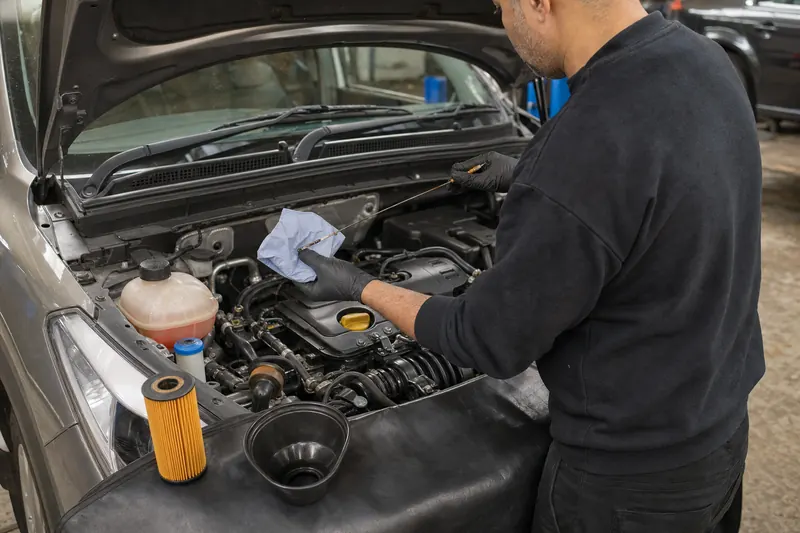
An interim service is the six-monthly oil and safety check; a full service is the yearly deep one. Here is what each covers, how to choose, and how service history affects your warranty. -
 Mechanical
Signs your brakes need replacing
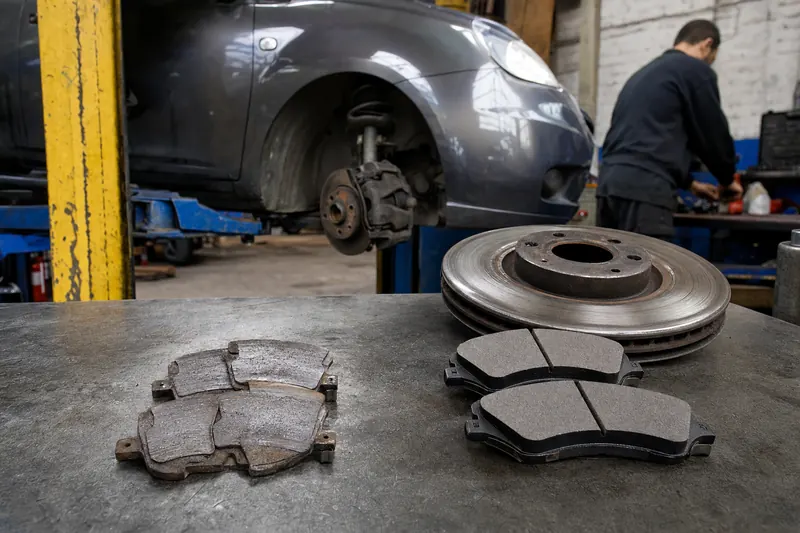
Brakes rarely fail without warning. This is what squeaking, grinding, judder, a soft pedal and pulling usually mean, which ones can wait a few days and which can't. -
 Mechanical
Car air con not blowing cold? Causes and fixes
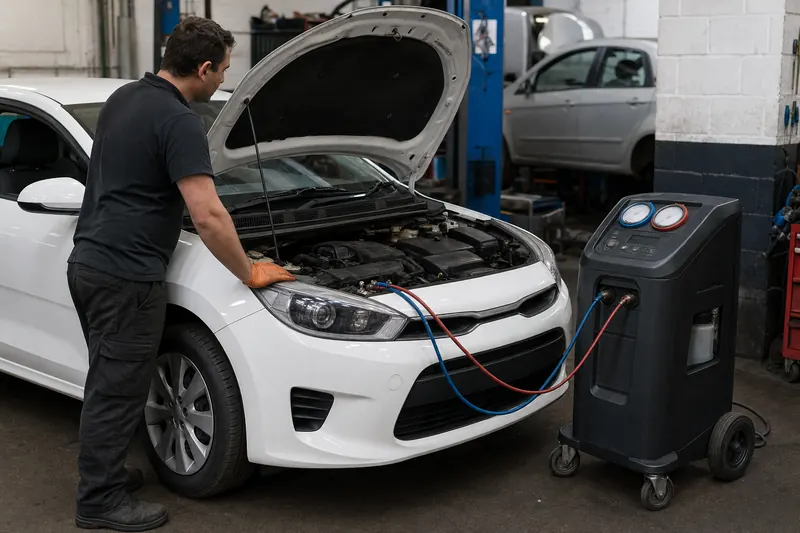
Warm air from the vents usually means low refrigerant, but not always. The common causes, how a regas differs from a repair, which refrigerant your car takes, and why air con matters in winter too.